FOIA.gov
Official site: https://www.foia.gov
What This Site Is
FOIA.gov is the federal government's central portal for Freedom of Information Act (FOIA) requests. It exists to help the public request access to non-public federal records held by U.S. government agencies.
FOIA.gov does not store the records themselves. Instead, it helps you determine whether a FOIA request is appropriate, identify the correct federal agency, submit a request directly to that agency, and track and understand FOIA activity across the government.
Each federal agency is legally responsible for handling its own FOIA requests — FOIA.gov coordinates the process but does not decide outcomes.
What You Can Do Here
- Learn what the Freedom of Information Act covers
- Decide whether a FOIA request is the right tool
- Identify the federal agency most likely to hold the records you want
- Submit a FOIA request to a specific agency
- Review agency FOIA contact information and processing times
- View aggregate FOIA statistics (requests received, processed, pending)
Start Here
Click or press Enter to enlarge
How This Page Works
FOIA.gov has two main navigation areas, each serving a different purpose. Understanding both will save time and prevent misfiled requests.
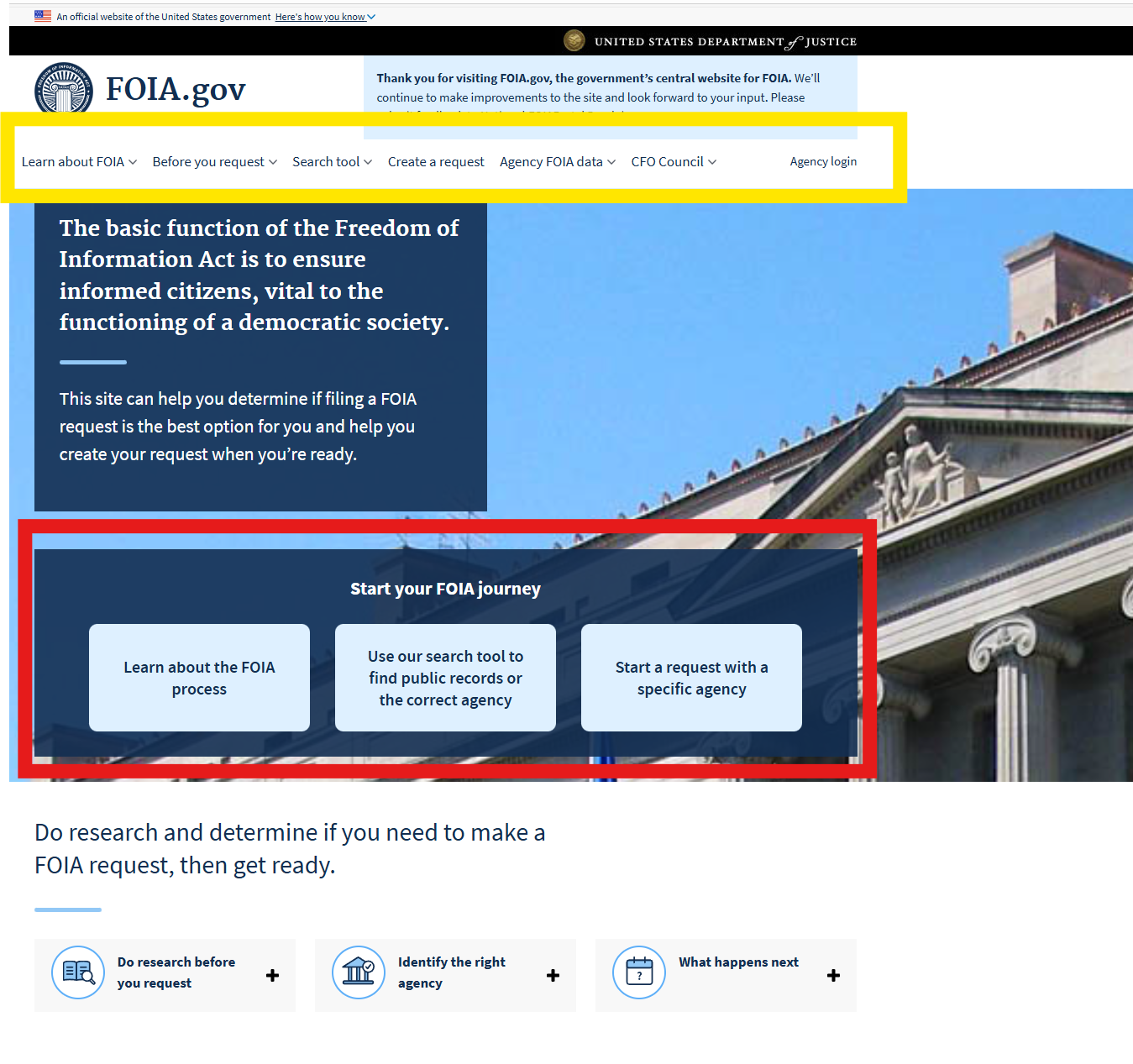
🔶 Yellow Box (Top Navigation) — Site Sections
The yellow highlighted navigation bar at the top contains educational tools, search guidance, and system-level data.
Use these links when you are learning, researching, or preparing.
- Learn about FOIA — Explains what FOIA is, what can be requested, and legal limits
- Before you request — Helps determine if a FOIA request is necessary and how to write one properly
- Search tool — Guides you to the correct federal agency based on record type
- Create a request — Begins the FOIA submission process once the correct agency is identified
- Agency FOIA data — Displays FOIA statistics such as request volume and processing times (Does not show request contents or released documents)
👉 The yellow navigation helps you understand the system and choose the correct path.
🔴 Red Box (Center Tiles) — Start Your FOIA Journey
The red highlighted section routes users based on how ready they are.
- Learn about the FOIA process — Best for first-time users or those unsure what FOIA can do
- Use our search tool to find public records or the correct agency — Best starting point for most users. Helps prevent delays caused by filing with the wrong agency
- Start a request with a specific agency — Use only if you already know exactly which agency holds the records
👉 Most users should start with the search tool, even if they think they know the agency.
Typical FOIA Flow
- Use the Search tool to identify the correct agency
- Review the agency's FOIA page (mission, processing times, contacts)
- Click Continue the FOIA request process
- Submit a clear, narrowly scoped request
Questions This Site Can Answer
- Do I need to file a FOIA request for this information?
- Which federal agency likely has the records I want?
- How do I submit a FOIA request properly?
- How long does a specific agency typically take to respond?
- What types of records are eligible under FOIA?
- How active is an agency's FOIA program?
- Are there alternatives to filing a FOIA request?
Most Common FOIA Mistakes
- Filing with the wrong agency, causing months of delay
- Making requests that are too broad or vague
- Requesting records that are already public
- Using FOIA for state or local records (FOIA is federal only)
- Asking questions instead of requesting existing records
- Requesting documents that do not exist in agency systems
- Including unnecessary personal information in the request
- Assuming FOIA guarantees full disclosure (exemptions apply)
When Not to File a FOIA Request
Do not file a FOIA request if:
- The records are already available on an agency's website
- You are seeking state or local government records
- You want real-time data or live updates
- You are asking for explanations, opinions, or analysis
- The information is court-sealed, classified, or legally exempt
- You need immediate access (FOIA responses take time)
In these cases, FOIA will likely be denied or delayed.
Good to Know
- FOIA applies only to federal agencies
- Agencies respond independently — there is no central decision-maker
- FOIA requests can take weeks to months, sometimes longer
- Processing time depends heavily on request scope
- Agencies may redact or withhold information under legal exemptions
- Denials can often be appealed
- Requests are tracked individually by agency
- FOIA.gov shows process and statistics, not document contents
Final Tip
FOIA is a precision tool, not a search engine.
The more specific and targeted your request, the faster and more complete the response.